Wednesday, September 21, 2016

Nomad of the ring!
Ngorongoro Crater (ring) – is an inactive volcanic bowl with rich wildlife beyond imagination, and in that this is a nomad male out of a group consisting of four nomad’s. This one behaved like shielding the group, strolling around and end up giving some shots; rest of the three choose to have a glorious nap even in the morning as their bellies were full. The story of nomad lions are well known and how they invade pride groups but seeing four together living in harmony was surprising. Nearby, there was another family, seems well settled but this bullies can unsettle any well-settled pride group. Wish I had more time to see and document what I anticipated is going to be a big conflict soon.


Monday, May 26, 2014

In Search of a Tiger - Tadoba Andheri Tiger Reserve

Call of the wild!

My indulgence with jungle books of Jim Corbett during school days would often transpose me to the dreamland of Big Cats. The ‘call of the wild’ never stopped echoing in my mind and, years later, the curiosity led me to several off the beaten paths in search of a tiger—just to shoot the elusive beast, but with a camera :)

Corbett — in his book ‘Man-Eaters of Kumao’— says, “A tiger is a large hearted gentleman with boundless courage and when he is exterminated—as exterminated he will be, unless public opinion rallies to his support—India will be the poorer by having lost the finest of her fauna.”

Corbett’s words seem prophetic; the tiger population in India is almost on the verge of extinction and less than 2000 grace our forests today. In such a scenario, catching a glimpse of these wild cats in a vast forest is like finding a needle in the haystack. However, it is indeed possible with the right set of information, passion, and patience.

Some of the popular places for Tiger sighting in India are Jim Corbett National park, Ranthambore, Bandhavgarh, and Kanha. But, the one I would like to introduce, which has also become my favorite over a couple of years is Tadoba Andhari Tiger Reserve—the reason being this less known forest in the central India is increasingly becoming populated – not with people but with tigers. It is now a popular Tiger habitat with almost 40-45 tigers (according to the 2013-14 census) living in the core and nearby buffer areas (relatively a small area than the 1000 square KM dense forest).

What makes Tadoba more interesting is its diverse animal and prey base. Besides tigers, the place is home to two other hard-to-find predators, i.e., leopard and the wild dogs (Dholes) – you have an equal chance of sighting them, though leopards are too elusive. It’s a dry deciduous forest full of bamboo shrubs, which serves as an ideal camouflage for tigers to stalk their prey easily without getting noticed. There are several other animals
that inhabit this forest—various species of deer (spotted, samber, barking and blue bulls), sloth bear, wild boar, bison, crocodile and various type of birds; enough to keep any nature lover excited with everything Tadoba has to offer in this hidden treasure.


How to track and sight a tiger?

Nobody can ensure a tiger sighting, but there is a lot one can do to increase the probability of a sighting.

Tigers are solitary animals, stalkers, and the leader of the forest; they are very quiet and elusive. One of the ways to track these wild cats is to observe the behavior of other animals in the forest—whenever a tiger moves or is in the vicinity, other animals give a distinctive panic/alert call, deer appear nervous and look at one direction, and monkeys jump on a tree top and make a peculiar sound.

Tigers are fond of water and loves playing in the water. Also, they don’t have sweat glands; hence, especially during peak summer when water becomes scarce, they are likely to come to the waterholes/ ponds at least few times a day – and this is where the hot spot for tiger sighting is.


Though tigers are solitary, a family with newborn stays together for up to two years, so if there a news of a family in a particular one area, the chances of sighting a tiger in that area are very high. Cubs are the bold, inquisitive and most playful ones, and fun to watch.

How to visit Tadoba or nearby places?

Tadoba located in Chandrapur district of Maharashtra in central India, just 135 km from Nagpur. Nagpur is well connected to major Indian cities by air and rail. From Nagpur, one can reach Tadoba easily by road.

Nagpur is known as the hub of wildlife in India—in addition to Tadoba, one can also visit Pench, Nagzira, Umred-Kharhandla, Kanha, and Bandhavgarh.

Where to stay and book permit for safaris?

There are different gates for park entry—Mohrali, Kolara, Kolsa and Navegaon; the first one is the most preferred because of easy accessibility and accommodation options. There are two resorts run by the forest department—MTDC Tourist Complex and Eco-Tourism complex; booking to both can be made through their websites given below:

1. http://www.maharashtratourism.gov.in/mtdc/Index/index.html

2. http://www.mahaecotourism.gov.in/Site/Common/nationalParks.aspx

It is important to note here that bookings should be made well in advance to ensure that you don’t face reservation hassles.

The Tourist Complex is surrounded by forest and water bodies with lots of birds; it is place where one can enjoy the joys of nature with the shrill of birds, deer calls, and even growl of Tigers.

Tiger Heaven - Telia Lake
There are other private resorts, though the options are limited; resort Tiger Trail, Serai and Saras can be a good alternative depending on budget.

Do not forget to book the safaris online from Mahaecotourism; it is easy and hassle free. There are various ranges in the park—book Mohrali range if you are staying in Mohrali; if unavailable, select Khatunda gate. The vehicle, an open six-seater jeep with a guide, needs to be booked separately.

Time to Visit?

Though the park remains open round the year, only the main road is accessible during monsoon (July-September). The comfortable time to visit is October-February when the weather is good and the forest has a lush green cover. Peak summer (March-June) is the time when maximum tiger sightings happen; however, temperature can reach 45° C during the period.

Given the diverse and rich flora and fauna, an adventurous trip is guaranteed in Tadoba. For those who like to explore off the beaten path and for those who like to enjoy the unique eco heritage of this country, this is the place to visit. And, if you happen to meet the large-hearted animal, do share the thrill with others, spread the word and make people aware of the need to save these majestic beasts.
Oriental Honey Buzzard

Leopard
Wild Dog (Dholes)
Samber Deer

Red Munia (Avdavat)
Bison


Wednesday, August 17, 2011

Audacity of a Tiger: My spectacular 4 days at Bandhavgar

Life goes on!! The name Charger, B2, Sita, Mohini, Jhurjhura hit the world fame, and now their descendants showing the sign of inheriting the charm from their parents to keep the hope alive.

1st week of June, I have had the fortune to witness some of the rare sight of the Big-Cats in its natural habitat, and this eventually turned out to be the best moments of my life in the wild to witness such actions. Photographing a mating pair and witnessing them courting for two consecutive days was my seer luck and beyoned imaginations. If thats not all, hide & seek with sub adults cubs perched inside bamboo shurbs, road block by a male cub and then following day a face to face eye contact with a mom of two cubs from 3-4 meters away interfacing us left my heart incessantly pounding. But still manage to get a shaky image as my hand throbbed with that questionable eye contact as to why I am there. Following this encounter unfolded another thrill, when mom lost interest on us, and minutes later pulled out the remains of a sambar deer in the firm clasp of her teeth and crosses the road with the kill to feed her cubs waiting other side of the road. Yes – these are the next generation tigers at Bandhavgarh, and no wonder why this place host so many as all of them displayed inheriting the grace from their renowned predecessors.


From here I’ll make it more of a photologue to blend the report with visuals. I’ll deliberately not explain much on travel and accommodation etc as this is a place anyone can have plethora of info on net. Bandhavgarh has facilities to suit everyone’s budget and need. I’ll primarily focus on what to expect from this place through the pictures and intend to give a visual treat to Big-cat and wildlife chasers :-)

Mukunda male cub (18 months), taking rest on the shade
Morning time seems best to rest in a cool dusty track
Dont disturb me! He was getting annyoed by the shutterbugs and the camera pointed towards him


Mukundam female (mom of the two cubs, one in earlier slide) coming out in the evening time and heading stright towards our vehicle!


Face to face from 3-4 meters. She stopped, and as if asking why are you here?? It was difficult to sustain the eye contact, image shaken as I couldn’t hold my hand firm, most importantly knowing that she is the mother of two cubs
 

<>
<>
 
Got it!! Remain of a Sambar deer which she kept it hidden


 Crossing the road. Mission: Get the kill to her cubs. Tiger hates to display their kill and always eats in private, secluded spot. She was moving fast to get away from us. I have heard the cubs growling soon after she inch a bit inside the bamboo shurbs and could see mom training the cub over the kill by not easily giving the remains of the kill to the cubs


A female cub was waiting in the other side, and she was desperate to take the kill before the cub comes out on the road – Tigers are extra sensitive toward their cubs, will never brings them to broad day light unless a situation warranted


Another Day 
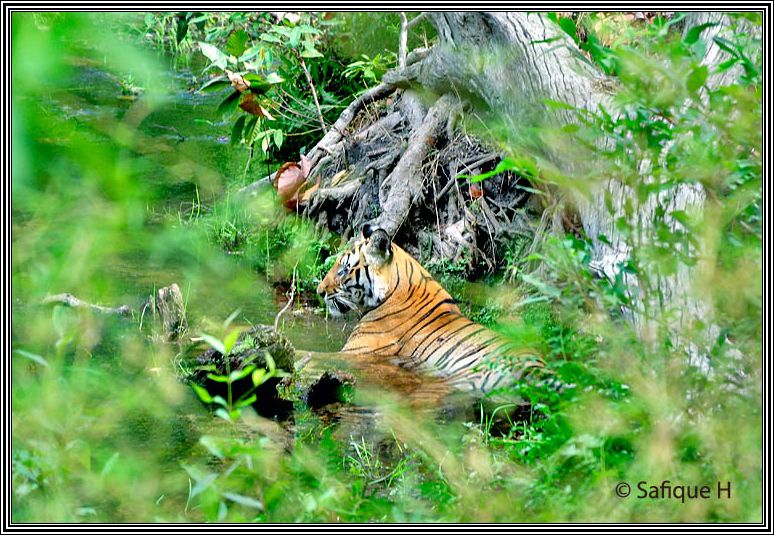
Evening time we sighted Kanketi resting on a water stream


Suddently she made her mind to move out


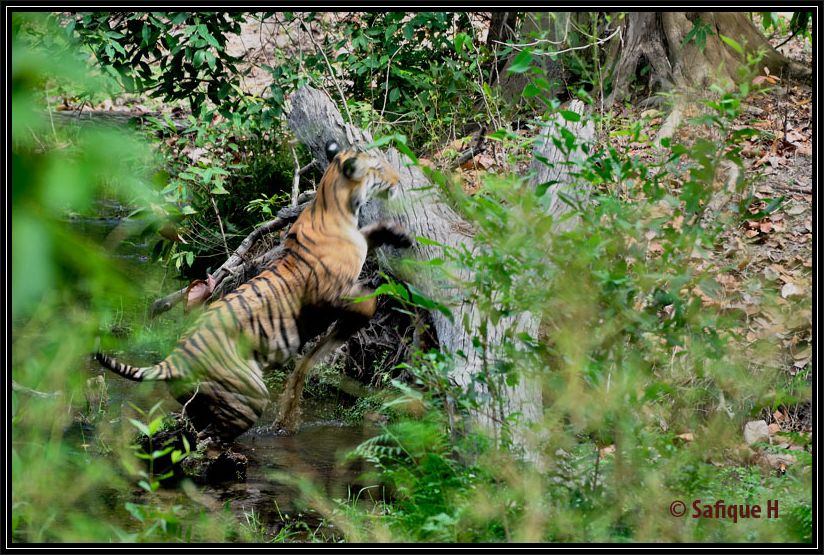
 Acrobatics: Jumping over the reclining tree to move towards the road


 This female was identified as Kanketi who recently in news of tiger cannibalism of killing and eating a portion of Chorbehera female in a territorial fight. She now took over this territory

 Twist: A huge fella appear behind the Jamun tree and started following Kankatis move - our guide screemed..Bamera..Bamera (dominant male). It was peak of mating season and the presence of Bamera presented a rare sight to be unfolded next


 Bamera following Kanketi who've already crossed and reached a shade near a water stream..

 Chasing this drama, with a nasty turn of the vehical I fell down flat on the middle seat...nobody helped :-) somehow got my balane, and what I saw after that was lifes best in the wild. Mating brins in new hope for the next generation after the 3 months gastation. A rare sight and my luck at its best this time....

The present king and the queen of Bandhavgarh and the new celibrity couple in making 

Bamera, he is huge and looks promising for B'garh


Another Day: Afternoon
This was the dominant male (Bamera) of Tala zone resting on a hillock in AC environment


 Twist: suddently emerged a female out of nowhere and she was none other then Kankati. Again, this presented the scope of sighting another mating episode..


Before I could blink my eyes, they went for mating - a pin drop silence and then large growls of Bamera flew all birds around..
 
 Light was tricky and my positin didn't alow a clear picture..still a record shot I guess..


Another Day: Early Morning


Perched and roaring inside a bamboo shurbs. These shurbs are best camouflage habitat for tiger, it also helps them to get to their preys easily hiding behind it..


 King appearing from his hideout in the golden light of the dawn, ensuring that I am not his prey to kill , before crossing the road


Crossed the road and disapper through the foliage, it was too hot and need some rest.


Kankati resting below a Jamun tree...flies dont disturb!!


I am sick of you guys, again here!! She'll most likely bring in good news after 3 months. I presume she had to make a kill that night or next becuase during mating period, 3-4 days, pair dont make any kill. This picture was after Bamera left for another zone..my abmitious wish is to bring Kanketi with her cubs from my next visit right in this blog..stay tune.


Wednesday, April 27, 2011

Tadoba: More then a Tiger Reserve


Indian Gaur
By Safique 

The name Tadoba (TATR- Tadoba Andhari Tiger Reserve) may sound a bit unfamiliar for many as it didn’t make much news for tourist until recently. This pristine forest in Chandrapur district of Maharastra flourished relatively in peace with  less human abuse and evils then some other forests in India. As a result along with varieties of other animals, birds, Tadoba become a safe heaven for the Big-Cats, the Tiger. With the gradual increase in Tiger Population Park was upgraded as Tiger Reserve in 1995. Per recent census March 2011 Tiger population has further increased from 42 to 69, in an area spread across 625 Sq. km. Needless to say what an accomplishment by park authorities in the midst of tiger crisis everywhere in the world. It was reported that as many as 28 tiger cubs were born in 2010.

   
Rudy Shelduck, Migratory, Nesting at Ladakh

In last couple of years media was active in reporting frequent tiger sighting stories by tourist, hence the place now become a hot-spot for tourist. May be good news for wildlife enthusiasts, particularly Tiger chasers, but definitely irritating for all the wild inhabitants. I got to know from Dieter Gutmann a German turist and Tiger conservationist who was staying next to our room, that recently in Bandhavgarh a safari vehicle hit a Tiger as they were racing to be the first to enter core zone. In turn the Tiger attacked two tourists in that vehicle. In May 2010 a Tigress with three cubs of 5 months old killed by safari vehicle in Bandvhgarh. Here in Tadoba as well, every water whole/stream, key spots are being scrutinized twice a day by thirsty eyes in safari vehicles to have a glimpse of the elusive Tiger.
  
Injured Tigress

We were greatly benefited by the presence of Dieter who gave a presentation to Ruby and I about the world of Tigers and how things changed for Tigers - and for us for that matter just in 110 years (In 1900 there was 100,000 in the world and now has hardly 4000. When it comes to India in the same period number dived 40,000 to now 1700, a massive failure worldwide caused directly or indirectly by humans). The most impending issue worldwide is of the proof that Big-Cats are shunting in buffer zone more often the earlier from the core zone (protected area) of national parks due to deforestation or lack of preys. Problem multiplies as buffer zones are aggressively encroached and this has significantly increased man-animal conflicts. I saw a direct evidence of this in Tadoba as forest authorities kept a caged Tigress, just three years old, near to MTDC resort. She had injured four persons, in retaliation villagers stuck with a sword and cut her nose. She is now undergoing treatment. In the buffer zone villagers enters forests to collect Mahua fruit (to make local liquor) and cuts grass for livestock. In sitting position Tiger mistakes them as their prey. These Mahua’s are also favorite food for wild bears found in Tadoba, and there were many conflicts with bears as well.


Grey Headed Fish Eagle

It was a three days tour to Tadoba, with total three safaris in the morning and evening. Ironically I didn’t sight a Tiger! Not to mean sighting is difficult, infact the probability is high, it was just not my time. But what I saw and sharing herewith may change the perception that visiting Tiger sanctuaries are not merely a success of sighting a Tiger but of really enjoying the rich bio-diversity and other varieties of wild species rather then passing common fuzz if Tiger dont appear. Many also don’t understand, but the wildlife and the forest echos "To know me give your senses a chance". Tadoba is one such Tiger Reserve (primarily), which I felt should equally be visited for its pristine and unique eco-system that has full of herbivores, carnivores and bird life. It was very different among other forests I visited; in the sense it is a dry deciduous jungle with small bamboo shurbs. From the first look itself place was looking like extremely congenial habitat for Tigers, especially to get to their preys hiding through these bamboo shurbs.

  
Spotted deer
 There are three ranges, Tadoba, Mohrali and Kolsa. Mohrali range is mostly visited by tourists, where MTDC has a resort (expect not more then basic/average facility and food with a lousy manager – if your focus is on wildlife more then resort you’ll be OK), there are two more resorts Saras & Tiger Trails (new) – looks better, off-course at double the price of MTDC. Kolsa is inside the jungle, mainly for birds and has a Forest Rest House (need advance booking from forest authorities). Mind you, park remains closed on every Tuesdays, but good news is park is open for the entire year, so no monsoon break. In Mohrali, some of the key spots are Telia & Erai dam, Jamunzora and the place we got in the last day with the highest animal density was called sector 97 in code language by the Guide. It was bit far from the gate, but worth visiting. I was not taken to this place until I insisted as someone spotted Tiger there in the morning.

Temperature may touch 40-42 degree celsius in the peak summer and an open vehicle (best for safari – though other vehicles are also permitted in Tadoba (unique) may drain lots of fluid out of you so need at least two litters of water per head. Another unique aspect, the safari duration is lengthiest in India, four hours each in the morning and evening. This provides ample time to even comfortably follow animal’s calls to trace Tiger or engage on photography with ease.
 
Indian Roller
 

Ruddy Shelduck

Main Mammals:
Tiger (69), leopards (28), wild dogs (1758), wild boars (195), sloth bears (165), bisons/gaur (1052), deer (2039), wild Cat, Ratel, Indian mouse deer, Sambar, Four horned antelope, Flying Squirrel, Hare etc.

Birds:
Different verities of goose, Egret, Heron, Rudy Shelduck (migratory), IBIS, Indian Roller, Verities of Drongo’s, Eagles, Bee Catchers, Junglefoul, Peefoul, Frencolin, Barbet, Sandgrouse and many more

Click Here to view the album

P.S: All comments, feedback, critical view, openinon welcome.

Friday, December 10, 2010

King of Jungles: Kaziranga, Nameri & Bhalukpong

The great one horne rhino  at Kaziranga - Bagori Range
By: Safique

Just like a migratory species of wild, I also return to Kaziranga during Nov-Dec every year. But this time I thought to package it with Nameri and Bhalukpong. Believe it or not – it turned out to be a thrilling experience, especially venturing Nameri forest on foot, and encountering wild jumbo, rhinos face to face, was a saga worth sharing

Kaziranga flourishing with the wild animals, I was extremely happy to see the conservation work inside the sanctuary, especially the way the habitat is being built and preserved. The growing rhino population (2048 now), is a testimony of these excellent ground work by forest staff. But on the contrary, I definitely hesitate to say the park is well protected from external poaching threats, and I felt situation is rather alarming. To my dismay the month I was there two mysterious death one tiger and a rhino was reported, and the horn of the rhino was missing. While traveling I spotted several illegal migrants recently encroached and put up their huts other side of the road/park near the eastern range (Bura-Pahar area). This remains as the key risk to the park. I read in the news paper that the forest ministry clarifies the other side of the road/park doesn’t come under them. Irony is - tackling risk to wild animal from poaching a de facto role of this ministry. What appears to me is Illegal migrants mushrooming in that area means, the vote bank is also growing at the same proportion, perhaps this is the most influencing factor then protecting animals.

Scenic tree & lots of animals the
other side of the lake - Bagori R
Need to mention that Kaziranga witnessed the horrifying history of carnage. By 1908 rhino population was almost driven to extinction, and left with around 12 individuals only. Over the years many poachers either caught alive or died in encounter were identified to be illegal migrants who are being used as field helper’s, originating from east Bengal/Bangladesh. Poaching risk multiplies with the present context, that more than a rhino habitat, Kaziranga now has world’s highest density of the big-cat (Royal Bengal Tiger), i.e. 32 tigers per 100 sq. km and the protected area is about 430 sq. km. Demand for tiger parts are ever known for which the entire world is struggling to save the big-cat from extinction, but very few knows that an Asiatic rhinoceros horn composed of keratin fiber is believed to have aphrodisiac value (used to cure impotency) and can fetch up to Rs. 1.5 million per kg in the international markets which are smuggled to South Asian countries. With these facts needless to say that this nature’s paradise is most naturally a poacher’s paradise as well.

Kaziranga housed 70% of the rarest one-horned rhinos, when the buzz and funding is at its peak to save tiger now, poachers most likely to turn their barrel towards their best alternative here. And guess what? This is actually happening, poaching has increased in the recent months, 10 rhinos were killed in this year till date. Park securities say it is impossible to guard the entire stretch of the park as poachers are always on the lookout for a fresh kill. Hence it is paramount that conservation not just focuses on building the habitat, and that’s actually been done fairly well, but the visible poaching risk from surrounding areas needs to be tackled wisely. Another disturbing fact, tiger conservation in India started in 1970. As a result tiger population increased from 1200 in 70’s to 3500 in 90’s, but suddenly 2008 census shockingly published that population dropped to 1411, and the primary reason was poaching. If this can be the reality, there is a full scope and potential that the 100 years of rhino conservation that build up the rhino population which is at its peak now, will continue to face the greatest risk to replicate a tiger like story.

Nameri and Bhlukpong:

Nameri is the secluded forest and share the easiest route from Kaziranga through Tezpur district. ). Located on the bank of river Jia-Voroli, Nameri is famous for Mahseer fish, Bison (The ferocious wild buffalo), elephants and Tiger (some even claims it has Black-Panther). This forest is secluded/untapped mainly because of its remote location, and the risk of local extremist. Bhalukpong is 30 kilometer ahead of Nameri (on the Arunachal border – gateway to China) . Here you’ll see nature’s majestic beauty surrounded by lofty mountains and Kameng River flowing out of Himalayas.

Bhalukpung - Kameng River
I thought to explore this hidden treasure and drove down to Bhalukpong first just after few day's of visiting Kaziranga. I was accompanied by Rajkishore (RK) - friend from my college days. RK and I share some good memories, especially bunking classes, and the scooter crash while riding on full throttle on the way to our picnic etc. From those days to these, a lot has changed, that time some of us will enter jungles/tea gardens to hide ourselves after bunking classes :-), and to play in the weekends. But today I venture on it to understand natural habitat. Those days I’ll veture forests with an air-gun with the intention to game/hunt – and I did for a long time, but when I came out of the teenage immaturity I realized that it is indeed important to shoot in nature, but with a camera not with a gun. Now whenever I enter a forest my concience reverbated with these impeccable nostalgia.
We reached Bhalukpong towards the afternoon and check-in to Directorate of Tourism bungalow (ATDC), this is the cheapest and the best one there for budget travelers. It can be bit confusing to find this place because in the same compound first (AP guest house) and last (IORA – Pvt) are different resorts, and this one is in the middle, we actually had to drill first and the last resorts to pint point this ATDC bungalow. After check-in, the staffers whispered that situation is tense since last couple of days, as extremist beefed up their activities. We decided to inform local police about our presence. We’re bit concerned especially because sun was setting and one of RK’s friend hadn't arrived as  yet. He was stuck in a nearby forest range office, and vehicles were not allowed plying without police escort after twilight. We appraise the situation to the local police in charge, and in-fact they picked him up in their escort van and dropped him right at the bungalow. It was already 7pm by then, and staffers again alarmed us about an elephant fury. They suggested us not to roam around outside much as last couple of days one single elephant roaming around in the night, and he often kicks opens the compound main gate to demand food and will not leave until something is given to him. I was quite curious to see this incidence as anyhow we’re staying in the upper floor – but guess what? He didn’t come that night at all.

Bhalukpong
The kitchen was empty as they only prepare depending on guest availability. We had to go to the nearby market and got the famous local river fish Hilghoria. It was tasty and cooked very nicely though. Upper floor has the best view of the river and the jungle. The vibrant sounds of the Kameng River flowing out of hills change its tune frequently as the air-flow changes. Slowly night got gloomier, the mix sounds of air, river, insects, animals, and birds have given me the real feeling of being in a wonderland. Next morning I got up early, packed my gears and moved towards the river through the forests. Morning was bit foggy; track leading to the river was narrow and covered with long grasses – definitely very scary and I was alone. After a while I discovered that I am actually walking on some pug marks. I look at it closely and these were medium size marks, very fresh must be of last night or early morning, because cracks on dust in the circles were clearly visible. It was not a dog or wild dog because no nail marks were visible. The wild cat family doesn’t leave nail marks (in a flat dusty surface) and you’ll not see those extra dots on fingers, unlike dogs. Hence I interpreted that it must be of a leopard or similar from wild cat category, but not a tiger. After about 5 minutes the sound of the river become more prominent, and the moment grass land ended I could see the beauty of fast flowing river over a thick layer of stones. Landscape was amazingly beautiful; I took as much pictures as possible. By the time RK also arrived to the river side, and we decided to go to Tipi, 3 km ahead of Bhalukpong to see the Arunachals famous orchid garden before leaving to Nameri.


At Tipi Orchid Garden
Our plan for Nameri was to do rafting first in the Jia-Voroli River and then the safari towards the after noon. But we miscalculated the timing, road leading to Tipi was so bad that we end up taking close to two hours time and arrived Nameri in the afternoon. Rafting is conducted from Nameri Eco Camp, run by Angling Association. They told us that rafting takes almost three hours, if we choose this then obviously we can’t go to safari, ultimately we decided in favour of safari, and I was quite disappointed missing the rafting opportunity. Without wasting time further, we contacted forest department to provide us a forest guide. Unlike other wildlife safari’s where one either has to go on a vehicle or on an elephant, safari at Nameri can be done on foot – sounds thrilling and risky? Yes - it was indeed a unique experience walking on woods. Other side of the river Jia-Voroli is the dense Nameri forests. We crossed the river in a small boat, this is the river where famous game fish Mahseer is found and the Angling Association allows protected fishing.

 After crossing the river I saw two forest guards waere carrying an injured barking deer on their shoulder.
Barking Deer - escaped from Tiger

Crossing the river Jia-Voroli
They found the deer deep inside the jungle, and he escaped from the tiger’s clutches with the back bone broken. Foresters now taking him for treatment to the nearby veterinary hospital. They said the deer will be OK after treatment and they’ll release him in the jungle. What a luck and life for this little creature. And what a devotion by these foresters. I couldn’t stop praising them. The guide accompanied us told that many time they seize fish or wild animals killed by poachers, but they’ll never eat them, instead they’ll burn it. I instantly believed him, as I saw the greatness and dedication with which they tried to save the deer, which could potentially be in the dinner table after escaping from Tiger. I witnessed a true love for nature, and these are true protectors of our jungles and should be titled as Forest Guardian rather Forest Guard.

Face to face w/the Jumbo
Immediately after entering the jungle trek I saw a big wild elephant and all my partners rejected to move ahead. Guide said, it must be our domestic elephant - dont worry! but when we were nearing I saw him staring at the elephant, and sensing his doubt I asked what happen? He slowly replied – ours one was actually bit thin! Suddenly I felt a mild tremor inside me hearing this, and the elephant was just 7 -8 meters away. I looked back and by the time my team mates were frantically running away. As I already pointed my camera, I didn’t feel like loosing this once in a life time opportunity come what may. I started clicking; grass was long and thick, and I was not getting the right exposure. The moment I clear these obstacles I saw a little baby (two – three weeks) appeared between her legs and then I felt the added danger. Elephants are normally very peaceful and follow group discipline. They are dangerous when they are alone or with a cub. Before charging elephant will always rise their ears and tail, and they can run @ 40-50 km per hour. I was obviously annoying her with my presence and the camera pointing towards her, and incessantly clicking as I was not able to frame the baby well because of thick grass. She started showing her discontent with a grumpy sound and started pushing the baby inside her leg. Realizing that I should know my limits, I stepped back before she raise her tail, becouse if she does, I’ll not have any chance.

It was a 5-6 km radius of trekking, we kept getting the smell of Bison, but didn’t see one – don’t know fortunate or unfortunate because all the foresters cautioned us that this is the animal who has the dubious distinction of charging human. Tigers stay deep in the jungles and mostly venture outside areas only in the night. Nameri also believed to have Black Panther. By the time we return to the base camp, sun was setting, and a huge flock of migratory birds returning by forming V shape. There were so many that the sky was almost filled with birds on top of our heads.

As it was already dark, forest staff informed us that one groups of elephant has already crossed the river, and we may face them in the village. It was a harvesting season and during this season maximum numbers of man-elephant conflicts takes place. I saw villagers covered their paddy field with open electric wires to flee elephants – though it is completely illegal but it seems they have no viable alternatives. Every paddy-field has a Machang (tree-top hut) but villagers said jumbo getting so used to crackers and other means that they don’t care at all.

We started driving back and RK was in the driving seat. It was a narrow village road and we’re right inside the village. All were talking about the amazing safari experience and was moving slowly, then I saw on the headlight something big is crossing the road, and before I could blink my eyes a massive elephant appeared in the middle of the road. I shouted Hati (elephant) – Stop!... RK said what? He braked instantly, but all inside the car got almost frozen. Our head lite remained on – Jumbo, who was about to cross the road, instead of doing so turned,and slowly coming towards us. I said switch-off the lights, RK switch off the lights and fortunately able to reverse the car, after a while he disappeared in the jungle. We came back and took another route to go to the main road.

Overall it was a journey 'Filled with Thrill' till the last moment. I discovered an amazing adventure zone that one can easily choose to go by clubbing these three places. If one has a week time then Bomdila & Twang can be added as an extension. Twang is bordering China, 180km from Bhalukpong (Arunachal Pradesh entry gate), is at a height of about 12000 ft. To go to Tawang you’ll need an interline permit, but for Bhalukpung not. Road connecting these place is quite bizarre now, but construction is going on which is likely to be completed by mid of 2011.

Route:
Guwahati --> 217 km, Kaziranga --> 140km, Nameri Eco Camp --> 30km, Bhalukpong --> 100km, Bomdila --> 40km, Dirang--->145km, Tawang

http://picasaweb.google.com/isafique/NameriNationalParkAssam?authkey=Gv1sRgCLus0_3p18_LzAE&feat=directlink

http://picasaweb.google.com/isafique/KazirangaNationalPark?authkey=Gv1sRgCIXKoMWSpo_9Ig&feat=directlink